
The Journal
The Courses of Los Cabos by Setting: Ocean, Desert and Links
Los Cabos golf spans clifftop ocean holes, desert canyons and wind-shaped Pacific links. A guide to the region's courses by landscape, and what each setting asks of your game.
Few golf destinations pack as much variety into as short a stretch of coastline as Los Cabos. Within roughly an hour’s drive, you can play holes that skirt the beaches of the Sea of Cortez, climb through granite and cactus in the desert foothills, and wind among towering Pacific dunes where the wind decides the club. Choosing courses by setting, rather than by name alone, is the most reliable way to build a trip that feels varied and suits your game.
This guide groups the region’s courses into three broad landscapes. Many layouts blend more than one, but each has a dominant character that shapes the experience.
Understanding the geography
Los Cabos sits at the southern tip of the Baja California peninsula, where the Pacific Ocean meets the Sea of Cortez. Cabo San Lucas faces both waters, with the Pacific coast running north toward Todos Santos. The Tourist Corridor follows the Sea of Cortez east to San José del Cabo, and beyond that lie Puerto Los Cabos and the quieter East Cape.
The two bodies of water behave very differently. The Sea of Cortez side is calmer and warmer, which is why the Corridor is lined with resorts and swimmable bays. The Pacific side is wilder, cooler and breezier, with broad beaches and dramatic dunes. Golf courses reflect those contrasts directly.
Ocean courses: the Sea of Cortez and the clifftops
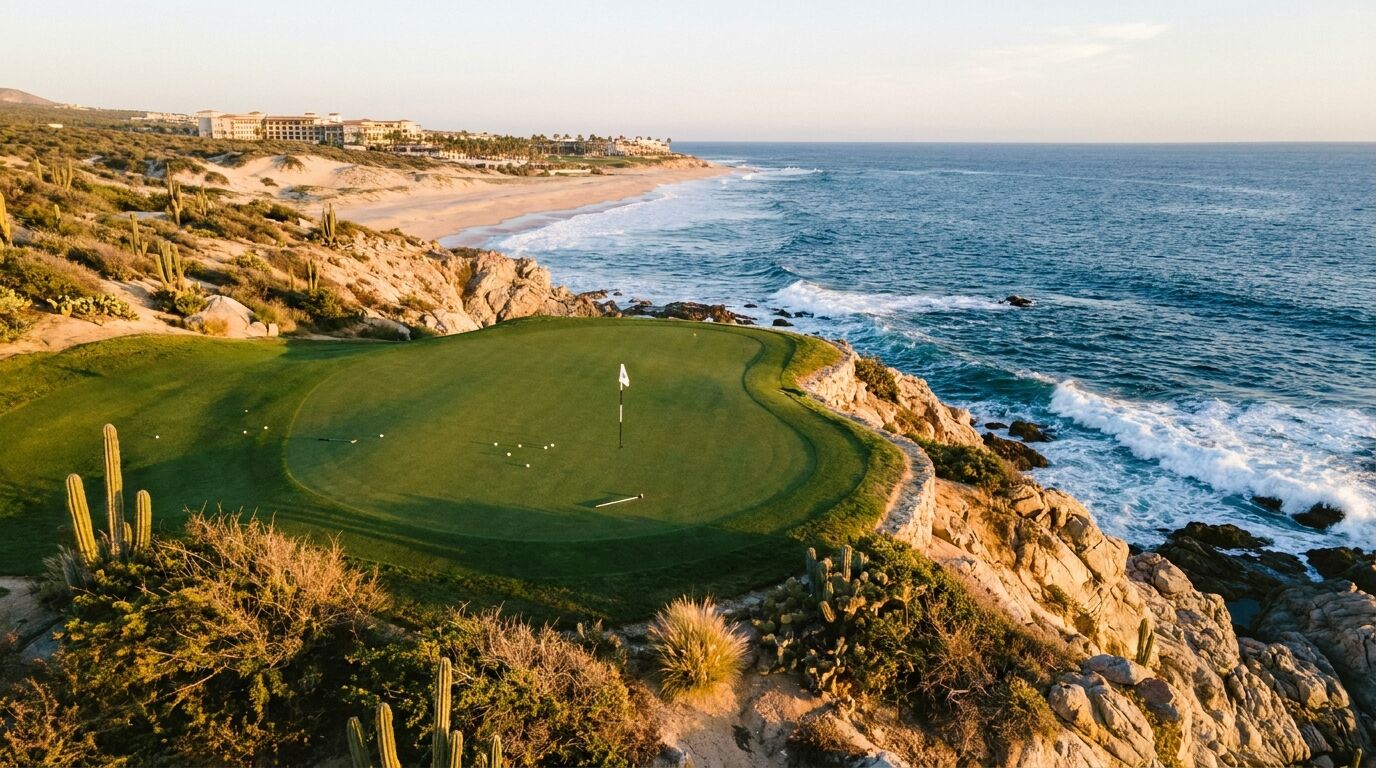
The image most golfers carry of Los Cabos is a green set against blue water, and the region delivers that in abundance. The ocean courses are the most photographed and, for many visitors, the reason to come.
Along the Corridor
The Ocean Course at Cabo del Sol Golf is one of the region’s most recognised layouts, with a Jack Nicklaus routing that runs along beaches and rocky points of the Sea of Cortez. Further east, Palmilla Golf Club combines canyon holes with long views to the water, and has a long-standing place in the history of golf in the destination. Private clubs on the Corridor, including Querencia Golf Club and Chileno Bay Club, are known for sea views from much of the course.
On the Pacific clifftops
On the Pacific edge of Cabo San Lucas, Quivira Golf Club is laid across granite headlands and dunes, with holes that play along and above the cliffs. It is a round of elevation and drama, with the ocean as a near-constant companion.
What to expect: spectacular scenery, a strong sense of occasion and, often, higher demand for tee times. Ocean holes can be exposed to the breeze, and missing on the wrong side is rarely forgiving.
Desert courses: canyons, arroyos and foothills
Inland from the coast, the land rises into desert foothills cut by arroyos, the dry riverbeds that carry water only after rare heavy rain. Courses here weave through cardón cactus, palo verde and rock, often climbing to elevated tees with sweeping views back to the sea.
Above San José del Cabo, Club Campestre San José is a Nicklaus design in the foothills, with arroyos framing the fairways and views down to the water from the higher holes. On the Corridor, Cabo Real Golf Club climbs into the desert hills before returning toward the Sea of Cortez, giving the round a strong desert-to-sea progression. Closer to town, Cabo San Lucas Country Club sits on gentle inland slopes with views toward Land’s End.
Several of the private clubs also have strong desert character. Twin Dolphin Club unfolds across desert ridges and arroyos above Santa María Bay, while El Dorado Golf & Beach Club moves between canyons and the coastline.
What to expect: target golf over native terrain, elevation changes that affect club selection, and often a calmer, more sheltered round than the coastal layouts. Accuracy matters more than raw distance.
Links-style courses: dunes and wind on the Pacific
The Pacific coast north of Cabo San Lucas offers something unusual in Mexico: links-style golf among natural dunes. These courses play firm and are shaped by the breeze, rewarding golfers who enjoy running the ball along the ground and adapting from one day to the next.
Solmar Golf Links, a Greg Norman design at Rancho San Lucas, moves through dunes, desert and open coastline where the wind becomes part of the strategy. Within the private Diamante community, Diamante Dunes Golf Course is built among large natural sand dunes alongside the ocean, with a traditional links feel and a caddie culture to match. Its neighbour, El Cardonal at Diamante, takes a more inland, strategic approach with wide corridors and contoured greens.
What to expect: wide views, firm turf, constant breeze and a premium on imagination. Scores vary with the weather more than on any other type of course in the region.
Settings at a glance
| Setting | Where | Character | Suits |
|---|---|---|---|
| Ocean | Tourist Corridor, Pacific clifftops | Water views, exposed holes, sense of occasion | Bucket-list rounds, photographers, special occasions |
| Desert | San José foothills, inland Corridor, Cabo San Lucas | Arroyos, elevation, target golf | Accurate players, calmer conditions, residents |
| Links-style | Pacific coast north of Cabo San Lucas | Dunes, firm ground, wind | Shot-makers, golfers who enjoy variety day to day |
Beyond the main corridor
East of San José del Cabo, Puerto Los Cabos Golf Course combines Nicklaus and Norman nines across rolling terrain with views toward the Sea of Cortez, offering a mix of desert and ocean in a quieter setting. Further up the coast at La Ribera, Costa Palmas Golf Club runs through native desert and palm groves beside calm water on the East Cape, a world away from the bustle of the Corridor.
Choosing a mix
For a balanced trip, most golfers do well to include at least one round from each landscape. A typical combination might be an ocean round on the Corridor, a desert round in the foothills above San José, and a links-style round on the Pacific. The contrast keeps every day fresh, and you will come away with a fuller picture of the destination.
The setting of a course often becomes the setting of a life, too. Many of the region’s golf communities have homes overlooking the fairways, and buyers often choose between ocean, desert and Pacific living in much the same way golfers choose a course. Our guide to owning a home in Los Cabos looks at how those settings translate into everyday life.
Before you go
- Decide which settings matter most to you, then build the itinerary around them rather than around names alone.
- Expect more wind on the Pacific and links-style courses, especially in the afternoon.
- On desert layouts, take an extra moment with elevation changes and favour accuracy over distance.
- Remember that some courses are private; check the access notes in our private clubs and golf communities section before planning.
- Bring a camera, or at least a charged phone, for the ocean holes.
Ocean, desert or dunes, each landscape in Los Cabos reveals a different side of the peninsula. Play across all three and you will understand why golfers return here year after year.
This guide is for general information. Details change, so please confirm specifics directly with each business. More from the Journal →